How to Practice Singing at Home: A Step-by-Step Guide for Beginners


You do not need a studio, a teacher, or expensive gear to make real progress. You need a simple routine and a way to hear yourself honestly. Here is both.
Key Takeaways
- You can make real, measurable progress singing at home with nothing more than your phone and a quiet corner.
- A good session is short and focused
- 15 to 25 minutes beats an unfocused hour, because focus fades fast.- Follow a simple order: warm up, breathe, match pitch, then sing a song in small sections.
- The one habit that separates fast improvers from everyone else is recording yourself and listening back, so you can hear what is actually happening instead of guessing.
- Track your progress over time so you can see plateaus and breakthroughs you would otherwise miss.
Why Practicing at Home Works (If You Do It Right)
Most singing improvement does not happen in a lesson. It happens in the hours between lessons, when you are on your own. That is good news: it means the bottleneck is not access to a teacher, it is having a routine you can repeat and a way to tell whether it is working.
The catch is that "just singing along to songs" is not the same as practicing. Repeating things you can already do, on autopilot, produces very little improvement no matter how many hours you put in. What works is focused practice on specific weaknesses with honest feedback - the approach we cover in the science of deliberate practice. This guide turns that principle into a routine you can run today.
Set Up Your Practice Space
You do not need much:
- A quiet room with minimal echo. A bedroom, a corner with curtains or carpet, even a closet with clothes around you. Soft surfaces reduce echo and make it easier to hear yourself accurately.
- Your phone. It is your metronome, your recorder, and your reference player. That is all the gear you need to start.
- Water. Singing is physical. Stay hydrated.
- Privacy, or being at peace with being heard. Part of practicing is being willing to make ugly sounds while you fix things. Find a time and place where that feels safe.
The 25-Minute Daily Practice Routine
Here is a simple, repeatable session. Adjust the minutes to fit your day, but keep the order.
1. Warm up (3 minutes)
Your voice is a muscle group. Warming up relaxes your vocal cords and prepares your breath. Gentle lip trills, humming up and down a comfortable range, and soft sirens (sliding from low to high and back) all work. Keep it easy. A warm-up is not a workout.
2. Breathing exercises (5 minutes)
Singing needs deeper, more controlled breathing than talking. A classic exercise: breathe in low (feel your belly expand, not your shoulders), then release the air on a steady "sss" sound for as long as you can hold it even and controlled. This builds the breath support that keeps your high notes from going flat and your long phrases from falling apart.
3. Pitch matching (7 minutes)
Play a note on a piano app or tuner, then sing it back and hold it. Then try simple intervals - sing two notes a step apart, then a wider jump. The goal is to train your ear to hear the distance between notes and your voice to land on them. If you are not sure whether you are matching, this is exactly where measuring yourself helps (more on that below).
4. Sing a song, in sections (10 minutes)
Do not sing the whole song top to bottom. Pick one section - usually the chorus, or whichever part is most exciting to you - and work just that. Get the lyrics. Sing the vowels. Slow it down. Break it into phrases. Nail one phrase before moving to the next. This is where the real improvement happens, because you are spending your time reharsing specific spots at a more granular level of detail.
Why short sessions win: focus research is consistent that intense, focused practice in 15 to 25 minute blocks produces better results than long, unfocused sessions. Two short sessions in a day beat one long one.
The Habit That Doubles Your Progress: Record Yourself
Here is the single most valuable thing you can add to home practice. Record the section you are working on, then listen back.
When you sing, your brain is too busy to judge your pitch and timing honestly in the moment - in fact, singers routinely overestimate their own accuracy. Recording moves the judging outside your head. Suddenly you can hear the note that goes flat, the phrase where you rush, the breath you ran out of. Things you could not feel while singing become obvious on playback.
The loop looks like this:
- Record the section.
- Listen back, and find the one biggest problem.
- Practice just that for a few minutes.
- Re-record and compare.
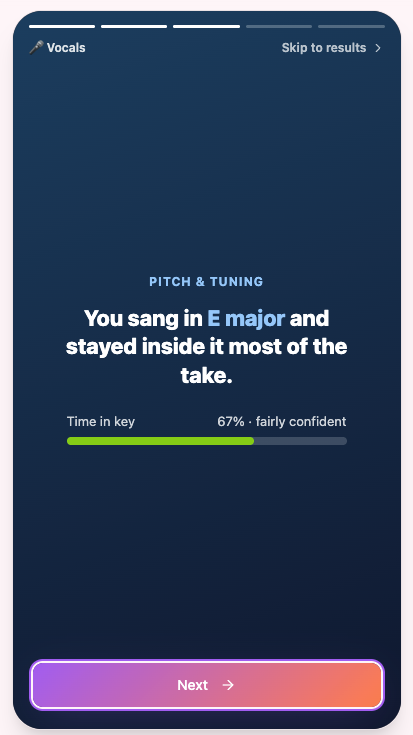
Even doing this by ear is powerful. Doing it with objective measurement - a tool that tells you exactly how in-key and on-beat you were - is faster still, because it removes the guesswork about what to fix. If you want to see how to do that, see how to test your pitch accuracy.
A Simple Weekly Structure
Daily sessions are great, but a little variety keeps you improving across the board:
- 2 to 3 days: technique focus (breath, pitch matching, range).
- 2 to 3 days: song focus (work a specific section of a song you want to perform).
- 1 day: record a full pass of your song and measure it, to track progress.
- Rest when your voice is tired. Pushing a tired voice builds bad habits and risks strain.
Track Your Progress (or You Will Not See It)
Improvement in singing is slow enough day to day that it is easy to feel like nothing is changing, get discouraged, and quit. The fix is to keep a simple record - a note of what you worked on and, ideally, a score for the section you measured. Over a few weeks, a trend appears that is invisible in any single session. Seeing "I went from 64% to 78% in-key on this chorus" is both proof your practice works and motivation to keep going.
If you are practicing between lessons specifically, we have a dedicated guide on how to practice between music lessons.
Measure Your Singing at Home - Free
The easiest way to close the feedback loop at home is to record a verse and get an objective read on your pitch and timing. Performance Coach scores a real take and tells you the specific notes to work on, so your next session targets exactly the right thing.
Get your first objective score - free
Record a verse. See your real scores. Practice the right thing tomorrow.
Frequently Asked Questions
How long should I practice singing each day?
A focused 15 to 25 minute session almost every day beats an occasional long session. Focus fades after about 25 minutes, and practice quality drops with it. If you have more time and energy, do two short sessions rather than one long one.
Can I learn to sing at home without a teacher?
Yes, especially the daily work. A teacher is valuable for guidance and catching technique issues, but the day-to-day loop of warming up, practicing in focused sections, and recording yourself can absolutely be done at home. Many singers combine occasional lessons with daily home practice and objective feedback tools.
What should a beginner practice first?
Start with breath support and pitch matching - they are the foundation everything else sits on. Then apply them to short sections of real songs. Do not try to master a whole song at once; work it in small pieces.
How do I know if I am improving?
Record the same section every week or two and compare. Improvement is too gradual to feel day to day, so you need a baseline to measure against. An objective score on the same passage over time is the clearest signal.
Will my neighbors or family hear me?
Probably, and that is okay. Soft rooms (carpet, curtains, a closet) muffle sound and also improve your ability to hear yourself. Pick a time that works for your household, and remember that making imperfect sounds is part of the process.
Keywords: how to practice singing at home, practice singing for beginners, singing practice routine, daily vocal practice plan, record yourself singing, improve singing at home.