
How to Test Your Pitch Accuracy (Free) - and What Your Score Actually Means

How to Test Your Pitch Accuracy (Free) - and What Your Score Actually Means
A practical guide to measuring how in-tune you really are, understanding the number you get back, and turning it into faster improvement.
Key Takeaways
- A pitch accuracy test measures how closely the notes you sing match the notes you are aiming for, usually as a percentage or in "cents" of deviation.
- Most free tests check single notes or short melodies. That is a useful warm-up, but it does not tell you how you perform on a real song, where breath, lyrics, and timing all compete for your attention.
- A score on its own is not the point. What moves you forward is knowing which notes you missed and which direction you drifted (flat or sharp).
- The fastest way to improve is the record, measure, adjust loop: test a real performance, fix the specific notes that are off, and re-test.
- You can get a full pitch and timing score on a song you actually sing, free, with Performance Coach.
What Is a Pitch Accuracy Test?
A pitch accuracy test listens to the notes you sing and compares them to a target. The target might be a reference tone the test plays for you, or the actual melody of a song. The test then reports how close you were.
You will usually see the result expressed one of two ways:
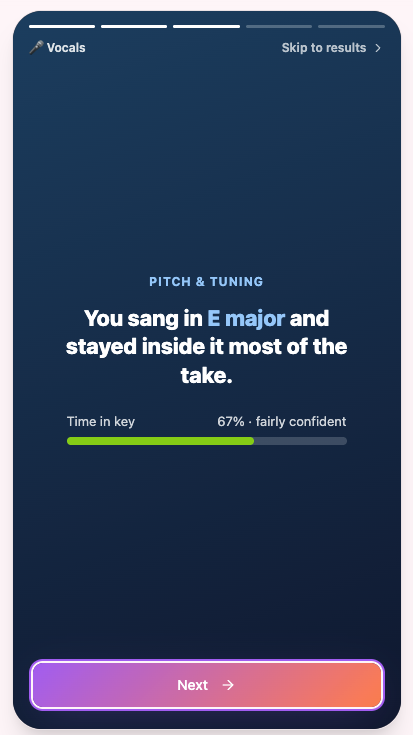
- A percentage - for example, "78% in key." This is the share of the time your pitch landed inside an acceptable range of the target note.
- Cents - a cent is one hundredth of a semitone. Being "15 cents flat" means you were slightly under the note, by a small but measurable amount. Most listeners start to notice pitch problems somewhere around 20 to 25 cents of deviation.
Both are just different ways of answering the same question: how close were you to the note you meant to hit?
Why You Cannot Judge Your Own Pitch While Singing
Here is the frustrating part. When you sing, your brain is busy. It is coordinating your vocal cords, managing your breath, recalling lyrics, keeping time, and adding expression, all at once. That leaves almost no spare attention for honestly judging your own pitch in the moment.
Research backs this up. Studies have found that singers tend to overestimate their own pitch accuracy by 15 to 20%, and that even trained musicians misjudge their own timing. This is not a talent problem. It is a bandwidth problem. It is also exactly why recording and measuring yourself works so well: it moves the judging job outside your head, where it can be objective. We cover this in depth in why recording yourself is the fastest way to improve pitch.
The Two Kinds of Pitch Tests (and When to Use Each)
1. Single-note and short-melody tests
These play a reference note or a simple 5 to 12 note melody and ask you to match it. You get a quick score.
Good for: a fast warm-up, checking your ear, confirming your mic works, and building basic pitch-matching confidence.
Limited because: singing one isolated note in a quiet room is much easier than singing the same note inside a song, with lyrics, breath changes, and a beat to follow. A high score on a single-note test does not guarantee you sing a chorus in tune.
2. Full-performance tests
These analyze you singing an actual section of a song - a verse or a chorus - and score your pitch across the whole passage. Some, like Performance Coach, also score your timing (how on-beat you were) at the same time, because pitch and rhythm problems often travel together.
Good for: knowing how you actually perform on real material, finding the specific spots that fall apart, and tracking real progress over weeks.
The honest tradeoff: full-performance tests take a minute longer because you have to record a real take. That minute is where the useful information lives.
Rule of thumb: use a single-note test to warm up, and a full-performance test to actually measure and improve.
How to Test Your Pitch Accuracy in 5 Steps
- Pick a short, real passage. One verse or one chorus of a song you know. Do not test a whole song. Short and specific beats long and vague.
- Set up a quiet space and a decent mic. Your phone is fine. Reduce background noise and echo (a small carpeted room or a corner works well).
- Record a baseline take. Sing it once, normally. Do not try to "perform for the test." You want your real, current performance.
- Read the breakdown, not just the number. Find which notes were flat, which were sharp, and where it happened (often the high notes, or the end of a long phrase where breath runs out).
- Fix one thing, then re-test. Pick the single biggest problem - say, going flat on the high notes - practice just that for 10 to 15 minutes, and record the same passage again. Compare.
That loop, repeated, is what actually raises your score. A single test is a snapshot. The loop is the training.
What Your Score Actually Means
A number like "73% in key" is only useful if you know what to do with it. Here is how to read it:
| What you see | What it usually means | What to do |
|---|---|---|
| Consistently flat on high notes | Breath support runs out near the top of your range | Work on breath support; approach high notes with more air, not more push |
| Sharp in loud or emotional sections | Over-singing / pushing | Back off the volume; let the note sit |
| Drifts off at the end of long phrases | Running out of breath | Plan breath marks; break the phrase |
| Off only on specific intervals | Ear training gap on those jumps | Slow practice of just that interval against a reference |
Notice that the score points you to a cause, and the cause points you to a fix. That is the whole value of measuring: it turns "that felt off" into "I go flat on the high notes when I run low on air."
Why a Single Number Is Not Enough
If a test only gives you a score and nothing else, it can quietly hold you back. A bare number tells you that you have a problem, not what it is or where it happens. Vague feedback like "that was okay" has very little effect on improvement, while specific feedback like "you were 58% on-beat during bars 9 to 12" gives you something to actually practice.
This is why the best use of a pitch test is not to chase a high score for its own sake, but to get a specific, repeatable readout you can practice against. The deliberate-practice research is clear that the quality of your feedback loop, more than raw hours, is what drives how fast you improve. We break that down in the science of deliberate practice.
Get a Full Pitch (and Timing) Score on a Real Song - Free
Free single-note tests are a great warm-up. When you want to know how you actually perform on a song, record a verse with Performance Coach and get an objective score on both your pitch and your timing, plus coaching on the specific notes to fix.
Get your first objective score - free
Record a verse. See your real pitch and timing. Start improving with data, not guesswork.
Frequently Asked Questions
What is a good pitch accuracy score?
It depends on the test and the difficulty of the material. On a real song, most developing singers land somewhere in the 60 to 80% in-key range, and trained singers push higher. More important than the absolute number is whether your score on the same passage is climbing over time. Progress beats any single benchmark.
Can I test my pitch accuracy for free?
Yes. Many tools test single notes or short melodies for free in your browser. To test a full performance of a real song and get both pitch and timing scored, you can record a verse free with Performance Coach.
Does being "flat" or "sharp" matter?
Yes, and the direction is a clue. Going flat (under the note) is often a breath-support issue, especially on high notes or at the ends of phrases. Going sharp (over the note) often shows up when you push or over-sing. Knowing the direction tells you what to fix.
Am I tone deaf if I keep missing notes?
Almost certainly not. True amusia - the genuine inability to perceive pitch differences - affects only about 4% of people. Most singers who think they are "tone deaf" simply have not trained their pitch perception yet, and pitch matching improves quickly with focused practice.
How often should I test my pitch?
Test at the start of a focused practice session to set a baseline, and again at the end to measure change. Day to day, a short test before and after a 15 to 25 minute focused block is plenty. The point is the before-and-after comparison, not constant testing.
Keywords: pitch accuracy test, how to test pitch accuracy, test my singing pitch, am I singing in tune, pitch detector, singing in key, record yourself practice.


